

Vulnerabilities have a way of coming back even after they have been fixed. Any new feature, refactor, or dependency update can unintentionally undo previous security improvements if there are no checks in place to catch regressions.
To help QA teams address this, SecureFlag has released three new Kotlin courses, covering beginner, intermediate, and advanced levels. Each course teaches learners how to write automated security tests that verify security fixes remain in place.
What is Security Regression Testing?
QA teams already use regression testing to confirm that code changes or new features don’t introduce problems. Security regression testing applies the same principle to vulnerabilities, checking that security fixes remain effective as applications change.
For example, after a team adds an anti-clickjacking header to an application, a regression test can confirm that the header is still present after every future deploy, catching when it disappears rather than waiting for someone to notice by accident.
Security regression tests can help teams:
-
Catch when previously fixed vulnerabilities come back.
-
Automatically check that security controls are still working.
-
Improve collaboration between development, QA, and security teams.
-
Find security issues earlier in the development process.
SecureFlag’s Kotlin Security Regression Testing Courses
The new Kotlin courses give QA teams practical experience in security regression testing, starting with the basics and progressing to more advanced techniques.
In the introductory course, participants learn the fundamentals of security regression testing, followed by the Intermediate and Advanced courses, which build on that with more complex testing scenarios and techniques.
Inside the Introductory Course
Learners write regression test cases that detect the return of previously fixed bugs, gaining a better understanding of each weakness in the process.
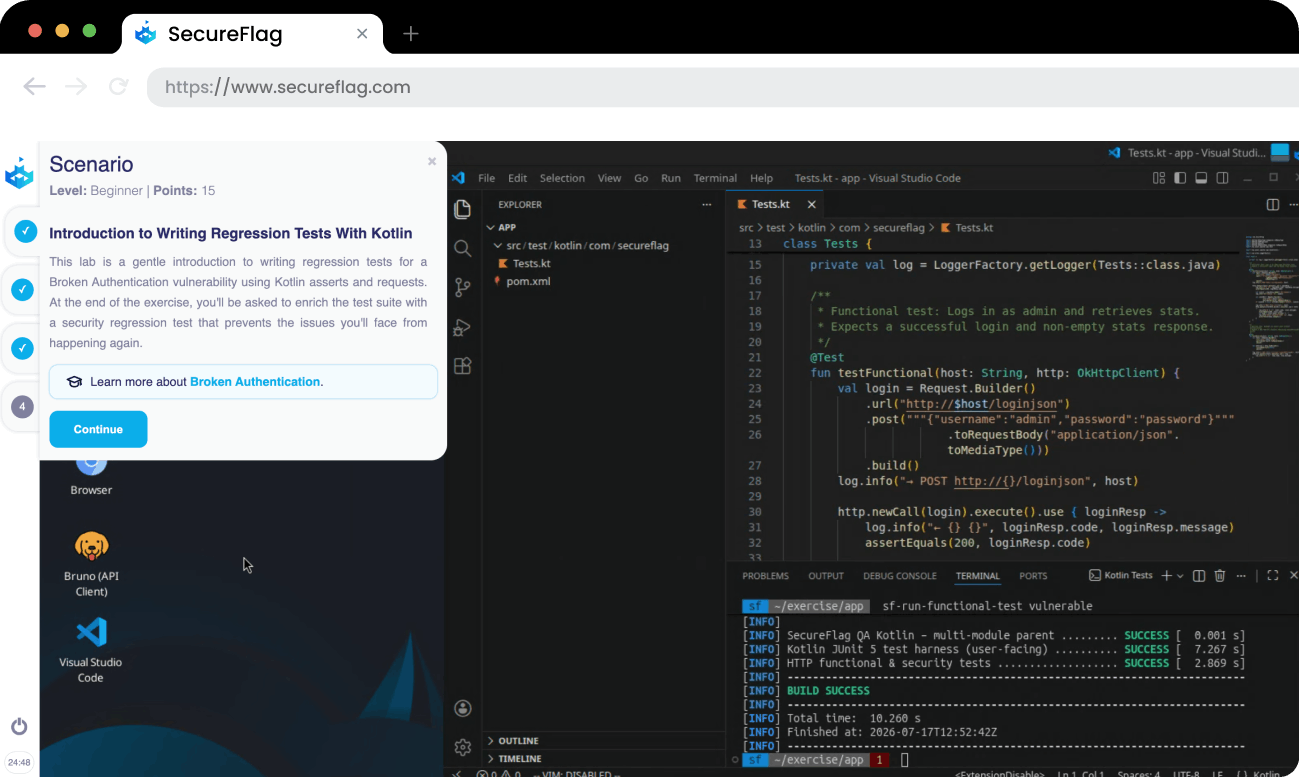
The course combines vulnerability theory with practical test writing. Learners first study a weakness, then exploit it in a lab, and write the Kotlin test that would catch it in the future.
Learners practice writing regression tests that:
-
Check for information disclosure.
-
Verify that anti-clickjacking HTTP headers are present.
-
Detect an SQL injection authentication bypass.
-
Validate server-side checks after a signup.
-
Confirm HTML link security attributes are in place.
-
Test for NoSQL injection on login forms.
The course assumes a basic knowledge of the HTTP protocol, basic Kotlin test-writing skills, and a general understanding of application security. After completing the course, learners will be able to identify common security defects and design effective regression tests to keep them from returning.
How SecureFlag Helps Teams Build Security Skills
SecureFlag provides hands-on learning in real development environments, so that teams can find and fix vulnerabilities in the languages and frameworks they use every day. Labs cover a wide range of technologies and roles, spanning developers, QA engineers, DevOps, and more.
Structured learning paths, such as the new Kotlin QA courses, guide learners from foundational concepts to advanced techniques, and training can be tailored to specific risk profiles.
Alongside the labs, ThreatCanvas, SecureFlag’s automated threat modeling solution, helps teams identify and address security risks at the design stage.
Want to see how SecureFlag helps build security skills across the entire development lifecycle?