
Teams building AI features probably each have their own definition of “secure,” which creates inconsistency. The OWASP AI Security Verification Standard (AISVS) fixes that, providing requirements for every stage of building and running an AI system.
SecureFlag’s new two-part course helps developers put the standard into practice through hands-on labs based on realistic AI security scenarios.
What is the OWASP AISVS?
The AISVS looks at AI security across the entire application lifecycle, from the data used to train a model to how it behaves once it’s live and interacting with other systems.
It focuses on the security risks that can arise from AI-specific components such as models and agents, as well as technologies that connect them, including the Model Context Protocol (MCP).
The standard is divided into twelve chapters. The first six cover the foundations established during development and deployment, while the remaining six focus on runtime and operational security.
SecureFlag’s two courses follow this structure, with each chapter paired with a knowledge base article and an interactive lab that lets developers put the requirements into practice.
The importance of practical AI security verification
AI security requirements can seem straightforward when reading about them, but that changes once developers have to apply them to an application.
Developers may be familiar with individual vulnerabilities such as cross-site scripting, but AI applications introduce new components and interactions that can create additional attack paths.
This is where AI security verification becomes essential. Developers need to recognize these security risks in the applications they build and understand how different security controls can prevent them. Hands-on practice can help turn unfamiliar AI security risks into problems developers know how to identify and address.
Course one: Build-time and platform security
The first course focuses on the foundations that should be in place before an AI system goes live, covering everything from making sure a model’s training data hasn’t been tampered with to the security of the model supply chain.
Each chapter opens with a knowledge base article that lays out the underlying risk, followed by a lab where the learner exploits and then fixes that same weakness.
The labs cover topics such as:
-
Preventing sensitive client information from being exposed through an AI model.
-
Exploiting indirect prompt injection to cause SQL injection through an AI agent.
-
Controlling access to unvetted models exposed through OpenAI-compatible APIs.
-
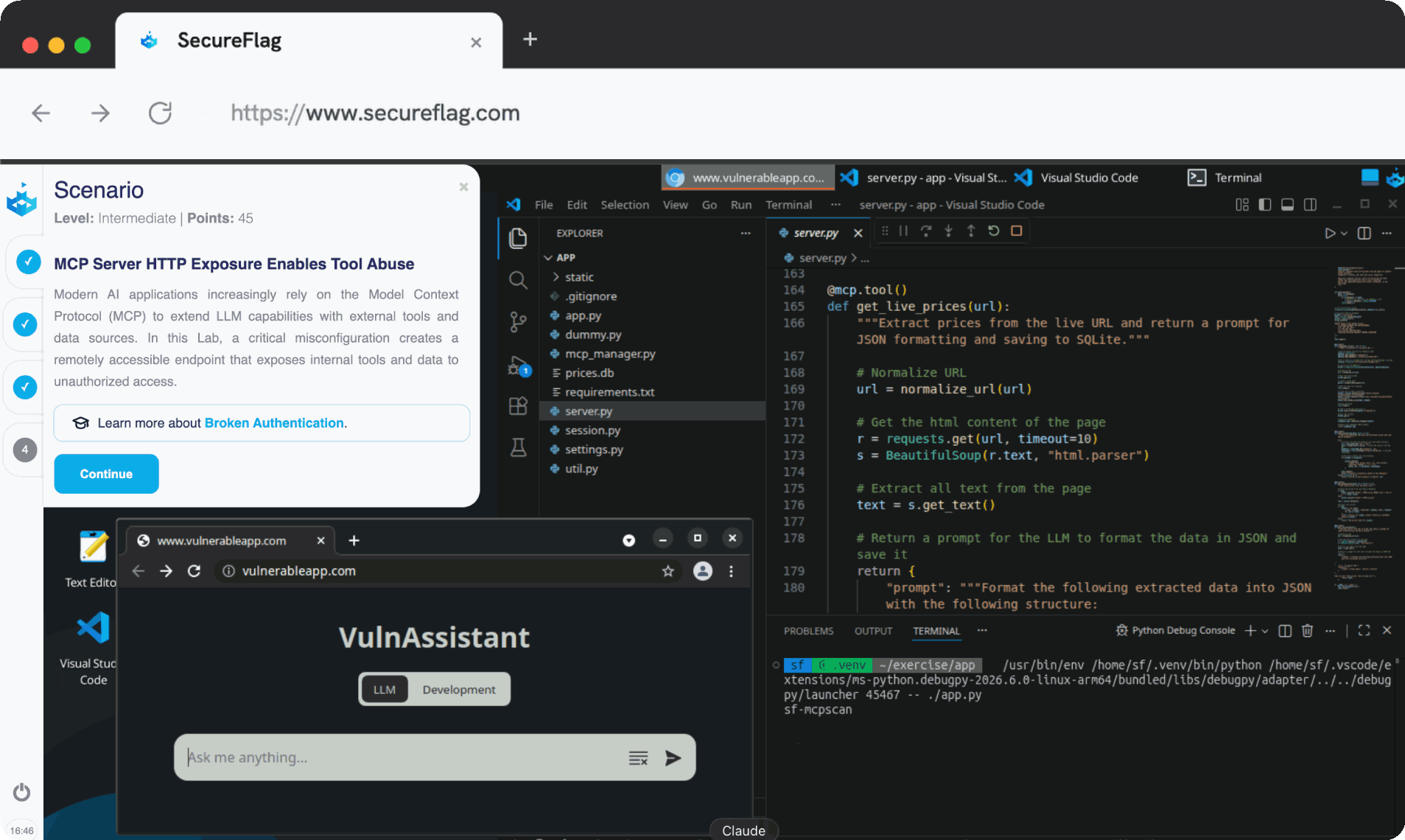
Protecting exposed MCP servers from unauthorized tool use.
-
Using OAuth authentication to prevent unauthorized access to MCP servers.
Course two: Runtime and operational security
The second course moves from the foundations of AI security into the risks that emerge while an application is running. It looks at how AI-generated output is handled, what information is available to models and agents, and how tools and MCP servers can be abused.
The labs explore practical runtime scenarios, helping developers see how an AI application’s build and setup can affect its security once it is up and running.
The labs cover topics such as:
-
Preventing AI-generated HTML from being used to introduce cross-site scripting.
-
Limiting the information shared through MCP conversation memory.
-
Restricting agent functionality to prevent command injection.
-
Protecting credentials from cross-server tool shadowing in MCP.
-
Preventing system prompts from being exposed through multilingual input.
Finishing this course rounds out the full standard, giving learners an end-to-end view of AI application security from the first line of training data to a live system under attack.
Build practical AI security skills with SecureFlag
SecureFlag’s hands-on labs give learners the chance to find and fix vulnerabilities in real development environments. They work directly with the code, apply what they’ve learned, and see whether their fix works. Each lab assesses the solution they implement, helping learners build practical skills they can apply to their own code.
The platform covers 70+ programming languages and thousands of labs, spanning everything from established languages and cloud platforms to emerging areas like LLM and agentic security.
New content is added regularly to keep pace with how these systems and their attack surfaces change, and the AISVS courses are part of that ongoing expansion into AI-specific security.