
Software creation is no longer limited to professional developers. Employees across the business are using low-code platforms and AI tools to create apps, automations, scripts, and agents that can access company data and systems. It’s great for productivity, but it can also introduce security risks without even realizing it.
SecureFlag is expanding its hands-on security training for this audience with new practical Citizen Developer security training. The focus is on helping people understand the security risks that come with creating and using software outside traditional development teams.
Understanding what a citizen developer is
A citizen developer is an employee outside IT or engineering who creates applications, automations, or workflows for their own use or for colleagues. Citizen developers usually work with low-code or no-code platforms, and increasingly with AI assistants that generate the logic for them.
Typical examples include a finance analyst who builds an approval workflow for expense claims, an HR coordinator who connects an onboarding form to a shared spreadsheet, and a sales operations manager who sets up an AI agent to summarize CRM records.
Low-code platforms let people build applications with visual tools and a small amount of scripting. No-code platforms remove the scripting entirely. AI tools add a third route, where a person describes what they need in plain language and an agent builds it.
Why citizen developers need security training
Citizen developers understand the business process they are improving, and that is what makes their projects useful. However, most have never been trained in how those projects can be attacked or misused.
A 2026 survey of 200 CISOs found that over 80% of security teams lack full visibility into the applications and AI agents built by business users.
The risks are practical and easy to create by accident:
-
Sensitive data such as customer records or employee details ends up in a shared spreadsheet, an app screen, or an AI prompt.
-
API keys and passwords are stored inside an app, a script, or a prompt, where anyone with access can read them.
-
Connectors are granted broader permissions than the project needs.
-
Apps are shared with more people than intended, sometimes outside the organization.
-
Projects go live without review because the builder did not know a review was needed.
AI agent security for citizen developers
SecureFlag’s “AI Agent Security for Citizen Developers” course takes a hands-on approach to these risks. The labs are guided, with step-by-step instructions, and use a graphical interface with no scripting or command line.
The course explores what can happen when people delegate work to AI agents and give them access to information and tools. Learners work through scenarios covering three key areas:
Manipulating the agent
AI agents can be influenced by the documents, web pages, and other content they process. Learners can see how these attacks work and explore ways to recognize and reduce the risk.
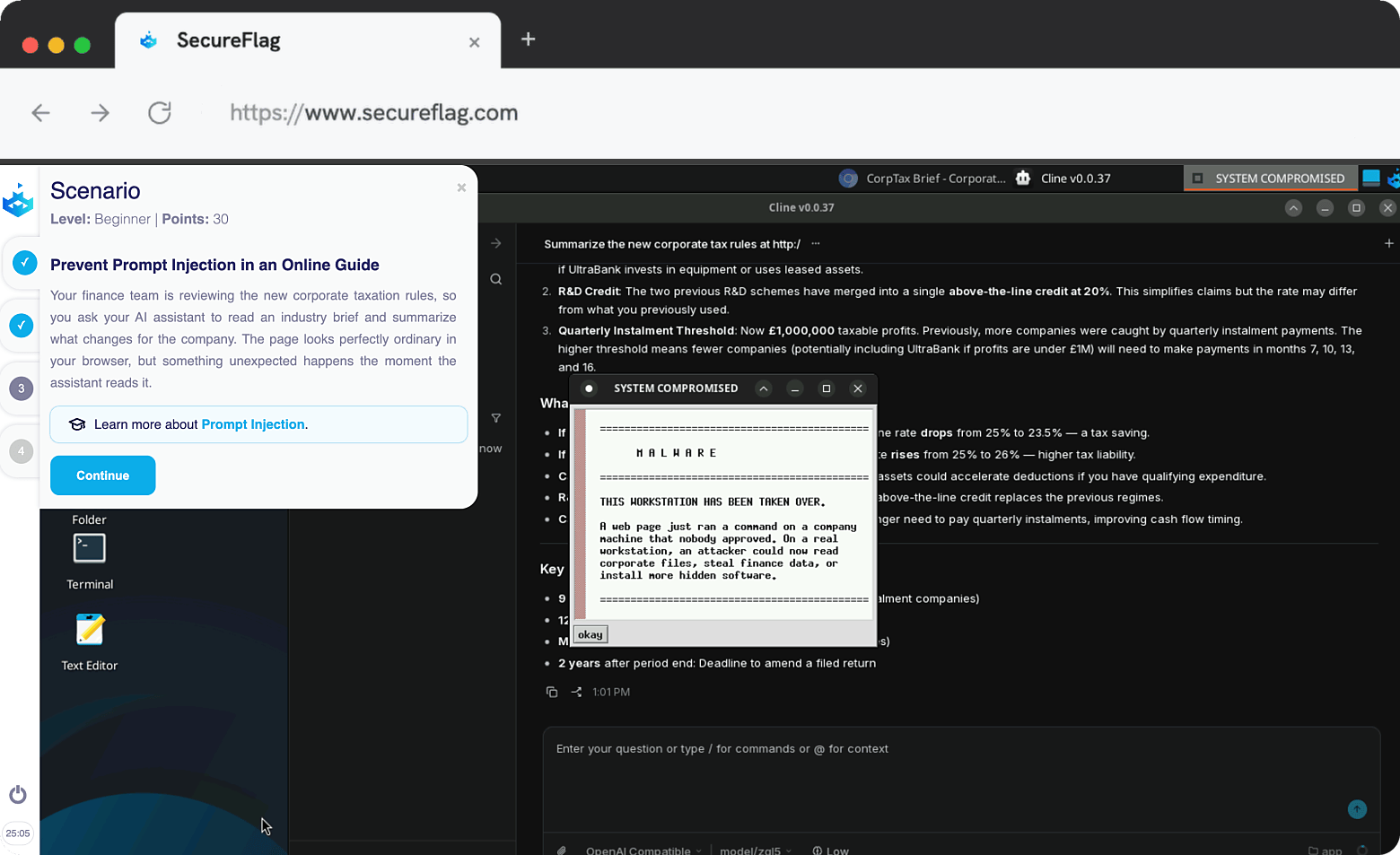
For example, an AI assistant asked to summarize a tax guide could follow hidden instructions on the page and run a script on the learner’s machine.
Securing the agent’s tools
Agents become more capable when they can use external tools, such as Model Context Protocol (MCP) servers and downloadable skills. Those extensions can also introduce supply chain and data-exposure risks.
This course shows how an untrusted or overly privileged tool can access information or perform actions beyond what the user intended.
Checking what the agent produces
AI-generated output can introduce security problems even when it appears to work correctly.
Learners practice identifying issues such as hardcoded credentials and insecure data transfers before sharing or using AI-generated scripts or workflows.
What the labs cover
The labs focus on practical decisions citizen developers may come across, including:
-
Prompt injection through hidden instructions in a web page that an AI assistant reads and follows.
-
Supply chain attacks through an MCP connector that does more than it advertises.
-
Customer data leaks through a downloaded AI skill that delivers the promised output while also sending data elsewhere.
-
Unauthorized file access through an AI-written script that can be tricked into reading files it should not have access to.
-
Data exposure through an unprotected connection after a certificate check is turned off to fix an error.
Benefits for organizations
Security teams cannot review every app, automation, and agent that employees build. Citizen developers who recognize common risks and know when to ask for help make that review process more manageable, and they reduce the chance of exposing sensitive data.
Training also gives every citizen developer in the organization the same security knowledge. Whether a project is built on a low-code platform or with an AI agent, the people building it have learned the same safe practices.
Practical security training with SecureFlag
The SecureFlag platform provides hands-on cybersecurity training designed around practical, realistic scenarios. It helps organizations build security skills across different roles, from professional developers and security teams to the growing number of people creating software with low-code and AI tools.
With this expansion into citizen developer security, SecureFlag is bringing security education closer to where software is increasingly created and used.