Part 3 of the security requirements series
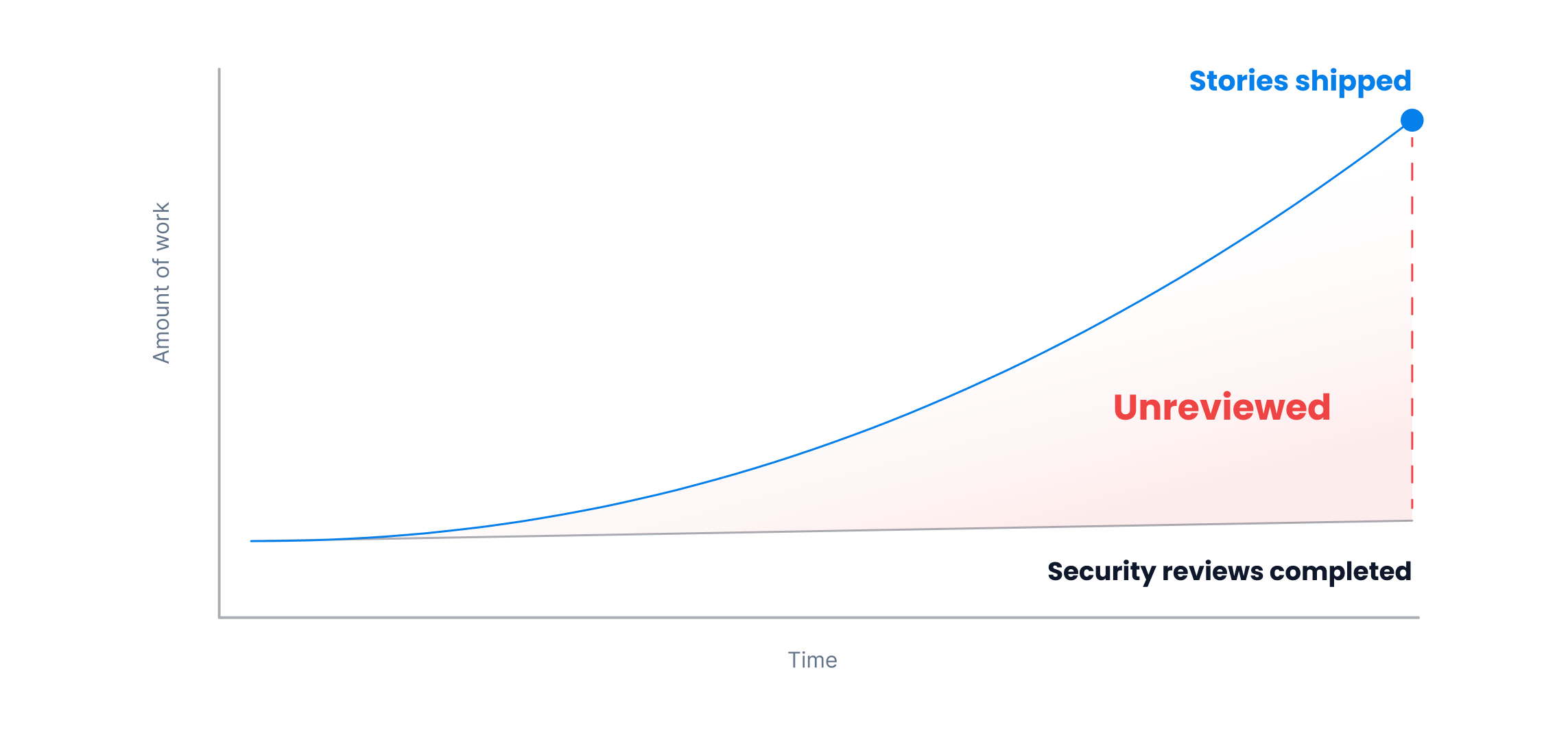
As teams release more code with AI coding assistants, keeping up with security reviews becomes harder. Security specialists are still working with much the same capacity, so they can’t review every story that goes into production. As a result, security leaders may be unsure which parts of an application have received attention.
This is the third and final post in a three-part series about security requirements. The first two followed a single password reset story, first as a ticket and then as a request to an AI coding assistant, whereas this post looks at all of the stories an organization releases in a quarter.
Security attention depends on who has time
Specialist time usually goes to the stories that someone reports as risky or brings to the security team directly. Those that aren’t reported generally move forward without that review, regardless of how much they change the system.
One way to see how often this happens is to look at the stories an organization released last quarter and check which of them had each of the following:
-
A threat model.
-
A written set of security requirements.
-
An author trained on the relevant technology.
In many organizations, only some stories have all three. The ones that do are usually those where the team has time, and someone remembers to ask, so coverage depends more on availability and memory than on how risky a story is.
The limits of prioritizing by importance
Focusing on the most important systems was a practical way to use a small team. Systems that were seen as critical got the architecture review and the penetration test, but internal tools usually got neither.
That approach works less well now, since the systems an organization considers important aren’t always the ones an attacker finds easiest to reach. For example, an internal admin tool with a direct database connection and only nine users probably wouldn’t make it on the priority list, even though it could be a likely entry point.
Prioritizing by importance always leaves some work without security review, which was acceptable while the leftover work was minimal. AI coding assistants increase the amount of code, so the work without a security review is becoming most of what a team releases.
The four steps for each story
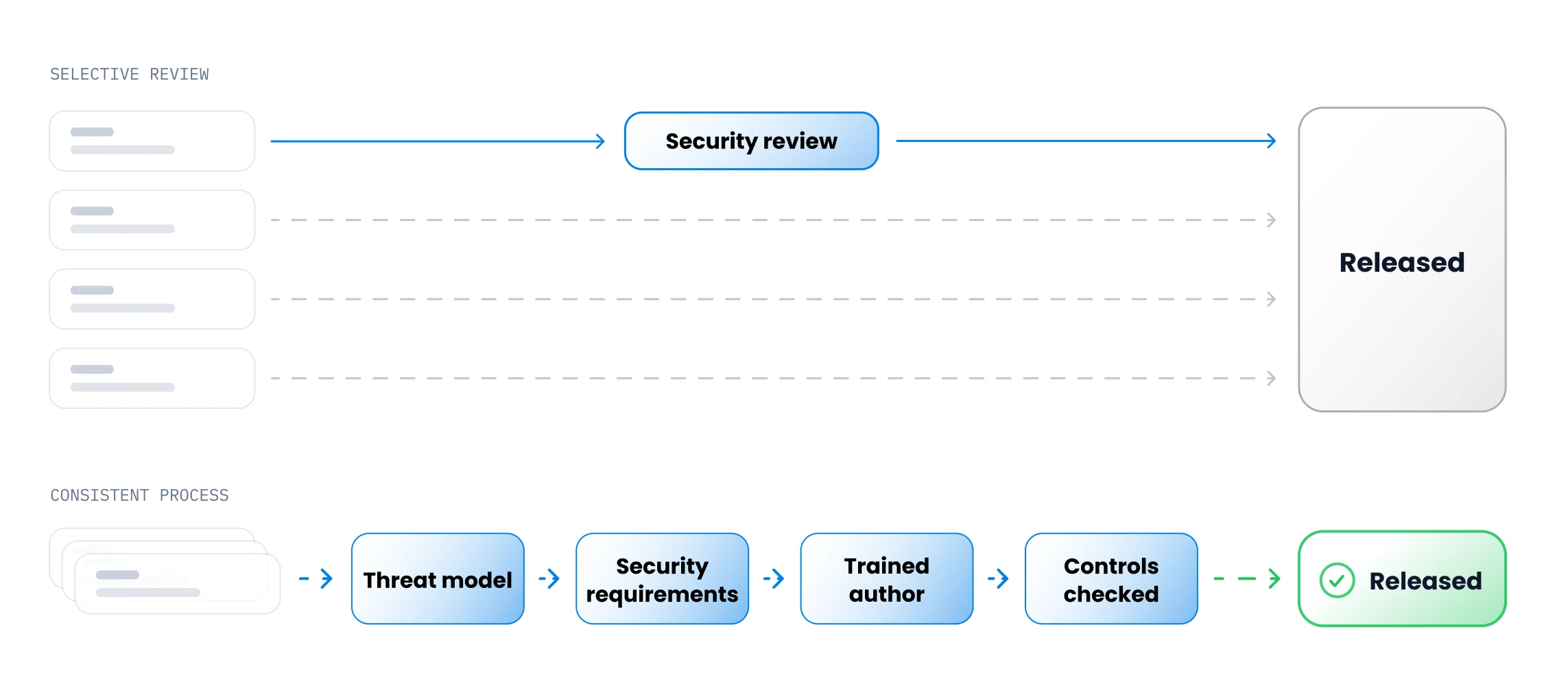
A lighter process that runs on every story works better than prioritizing. Each story goes through the same four steps, with no exceptions:
-
A threat model, even a brief one, to show how the feature could be attacked.
-
The security requirements that follow from that threat model, taken from the standards the organization already uses.
-
Confirmation that the people building the story are trained on the technology involved.
-
A check after the build that the controls made it into the code.
Each step can be short, as long as it happens on every story. When AI is producing code this quickly, applying the same process to every story is the main safeguard. The biggest risk is work the process never reaches, which is hard to identify because there’s no record of it.
Showing that the same process ran
If an organization can’t demonstrate consistency, it has no evidence to offer when responding to an audit or an enterprise security questionnaire.
Proving it means having a record of each of the four steps for every story that was released. If one of them is missing for a story, that story can’t be shown to an auditor as covered.
A security leader therefore needs to be able to answer two questions:
-
Looking backward at code already in production, was it written, or accepted, by people with the right training?
-
Looking forward at stories about to be released, is everything the process calls for already in place before release?
Most organizations can’t answer either question with evidence today. They can usually point to a written policy and a sample of reviewed pull requests, which show intent but say little about what happened across all of the work.
That leaves one question to end the series, and it applies to any organization releasing code with AI assistance.
If the same security process is not running on every piece of work a team releases, how would a security leader know?
Supporting secure software development
SecureFlag helps organizations apply the same security practices across all software development, so coverage doesn’t depend on which story gets attention.
Hands-on training, including Agentic Coding Labs, gives developers the skills to build and review code securely when AI coding assistants are involved, and automated threat modeling with ThreatCanvas makes it practical to create a threat model for every story.