
Threat modeling often gets a bad reputation for being slow and disconnected from everyday development, but it doesn’t have to be. When using the right threat modeling methodology, developers can identify risks early and ensure that security is an integral part of creating great software (without spending hours in meetings!).
Considering that a single data breach in the U.S. now costs over $10 million on average, it’s easy to see why threat modeling is crucial.
Why Use Threat Modeling?
Essentially, threat modeling helps developers think like an attacker, as well as understand the system, identifying potential issues and fixing them before someone more malicious finds them.
-
Understand your system better: Mapping components, data flows, and trust boundaries helps teams understand complexity and dependencies early.
-
Find issues before attackers do: Catching risks in design or code review is more cost-effective and faster than patching production incidents, and prevents costly data breaches.
-
Improve collaboration: Developers, security engineers, and architects work from and collaborate on the same model, making conversations more solution-focused.
-
Define and enforce security requirements: Teams can identify and incorporate security requirements during development, ensuring that security controls are adequate and risks are mitigated.
-
Build more secure software over time: Continuous threat modeling means you’re always updating your security posture, not just reacting to threats.
What Is a Threat Modeling Methodology?
When following a threat modeling methodology, developers can break down software systems into components and identify potential threats in a step-by-step, repeatable way.
It makes security more manageable while also ensuring that all team members are aligned when it comes to risk and security vulnerabilities. A threat modeling methodology gives teams a structured approach to identify, assess, and mitigate risks.
Threat identification is a central part of it, that is, finding vulnerabilities and attack vectors early, before they can be exploited.
Benefits of a Threat Modeling Methodology for Risk Assessment
One of the benefits of using a threat modeling methodology is that it brings security into the development process and supports risk management, rather than leaving it as a separate, one-off task.
Teams catch issues early, prioritize risks, and plan mitigations that don’t slow down development. Also, having a shared framework makes collaboration easier because no one enjoys having to explain the same threat repeatedly in meetings.
In general, threat modeling provides a consistent way of thinking about risk, rather than having to start from the beginning each time.
What Are the Steps of Threat Modeling?
Although each methodology has its own focus, most threat modeling processes follow a similar set of steps. Developers can think of these as a repeatable loop, sort of like unit testing for architecture, but ideally less tedious.
-
Define the scope: Identify the system, feature, or service you’re modeling, including its assets such as credentials and data, to ensure complete security visibility.
-
Decompose the system: Break it into components, mapping data flows, and defining trust boundaries.
-
Identify threats: Use a methodology to systematically find what could go wrong by analyzing threat agents, developing threat scenarios, and classifying threats.
-
Assess risk and prioritize: Assign risk values to each threat and conduct risk and impact analysis to rate each threat by impact and likelihood.
-
Mitigate and plan: Decide how to fix or reduce the risk through code changes, configuration updates, or architectural adjustments.
-
Validate and iterate: Review with peers, and update the model as the system evolves.
What Are the Five Basic Components of Threat Modeling Methodology?
A good threat modeling methodology covers five main components:
-
Assets: What you’re protecting, such as data, services, and users.
-
Threats: The possible events or attacks that could compromise those assets, including potential security threats and attack vectors that an attacker might exploit.
-
Vulnerabilities: Weaknesses in design, code, or configuration that threats could exploit.
-
Mitigations: Security controls or design decisions that reduce risk.
-
Risk Rating: A way to measure severity so you can prioritize fixes.
Including all five components ensures that your threat model is practical rather than just a list of possible scenarios.
The Major Threat Modeling Methodologies
Not every team approaches threat modeling the same way, which is why multiple methodologies exist to help organizations identify and manage security risks.
When choosing a methodology, it’s worth considering threat mapping, which involves assessing how attackers might target systems and ensuring that security measures align with business goals.
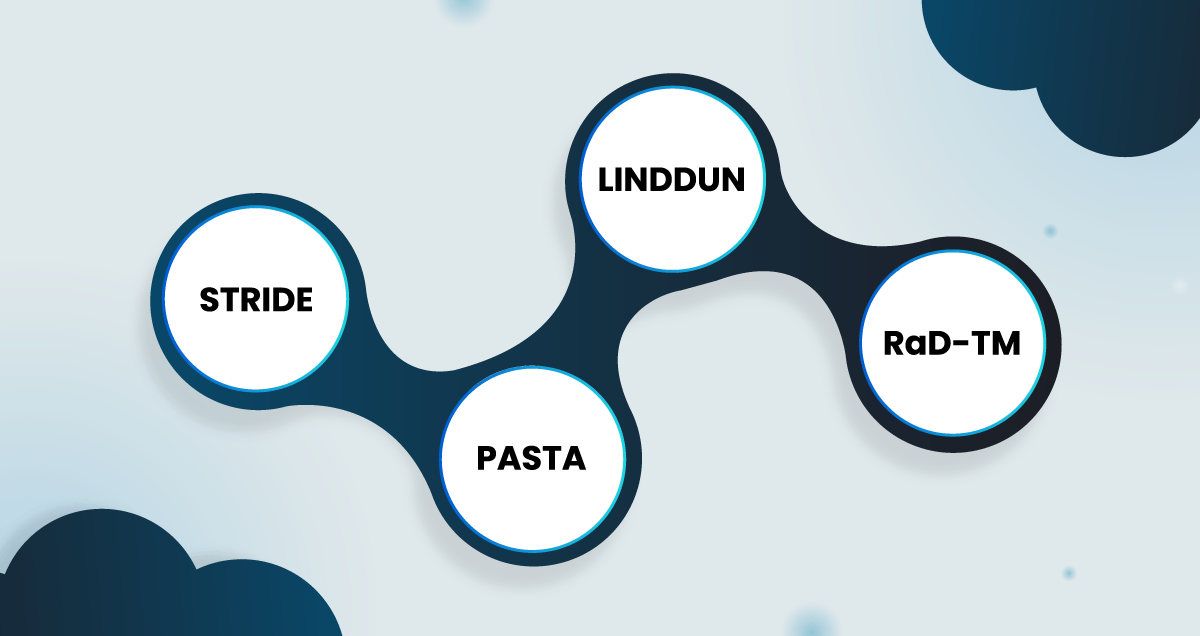
Here’s a look at the primary methodologies teams are likely to encounter and why developers find them helpful.
STRIDE
STRIDE, created by Microsoft, is one of the most widely used methodologies for analyzing security in software systems.
It categorizes threats into six groups:
-
Spoofing
-
Tampering
-
Repudiation
-
Information Disclosure
-
Denial of Service
-
Elevation of Privilege
Developers often appreciate STRIDE because it provides a checklist to work through systematically, making sure nothing is missed.
The downside is that it can become time-consuming when applied to very large or complex systems, particularly if every component is analyzed in depth.
PASTA
PASTA (Process for Attack Simulation and Threat Analysis) is a seven-stage methodology that takes a risk-centric approach.
It’s highly detailed and guides teams through defining objectives, decomposing the application, analyzing threats and vulnerabilities, simulating attacks, and prioritizing risks.
It’s thorough, which is ideal for critical systems, but it demands time, expertise, and commitment. It works best for high-stakes environments, but maybe too heavy if your release cycle is measured in weeks, not quarters.
LINDDUN
LINDDUN focuses specifically on privacy threats and organizes them into categories, including:
-
Linkability
-
Identifiability
-
Non-repudiation
-
Detectability
-
Disclosure of Information
-
Unawareness
-
Non-compliance
It’s beneficial if your team handles personal data or needs to meet privacy regulations like GDPR or HIPAA. If your system doesn’t deal with much sensitive user data, though, LINDDUN might not provide much additional benefit.
RaD-TM: Rapid Developer-Driven Threat Modeling
Traditional methodologies can be useful, but they may also feel a bit intimidating or slow. RaD-TM, however, is lightweight and makes threat modeling easier for developers.
Instead of trying to take on the entire application at once, RaD-TM focuses on individual features. Developers familiar with specific parts of the system can quickly create an accurate threat model with the help of automated threat modeling solutions, like ThreatCanvas.
The features of an application that should be prioritized are those that are most critical for security, such as access control, payment processing, or handling personal data.
RaD-TM also uses risk templates, which are predefined sets of threats and controls. They are customized for different technologies and compliance needs, and can help teams identify risks and attack vectors more quickly, without always relying on security experts.
The goal is to keep threat modeling small, regular, and close to the code, so security becomes an everyday part of the development process.
How Developers Can Make Threat Modeling Work
If you’re a developer, here are some practical ways to adopt threat modeling without slowing down the projects being worked on:
-
Start small and specific: Focus on the feature you’re working on, such as a new API endpoint or user registration flow, rather than trying to model the entire system at once.
-
Think like an attacker: Try to figure out how an attacker would break something to compromise the system. For example, it could be malicious file types, large uploads, or unexpected inputs.
-
Make it part of your workflow: Start threat modeling during the design phase, while features and architecture are still flexible.
-
Collaborate early with security: Involve your security team during design reviews, not after you’ve written hundreds of lines of code. They can help find risks you might overlook and help prioritize what’s crucial.
-
Document your reasoning: When you mitigate a threat or accept a risk, take a note of it. Future developers will understand why controls like rate limiting or input validation were added.
-
Keep models alive: Update your threat model whenever you add features, integrate third-party services, or change data flows.
-
Use templates and frameworks: Don’t reinvent the wheel; instead, use risk templates for common patterns such as authentication, API security, or data handling. It saves time and ensures nothing obvious is missed.
OWASP has a threat modeling cheat sheet for developers to use as a reference.
Threat Modeling Challenges
Even with a sound methodology, teams can run into challenges. Overcomplicating the process can make models difficult to maintain, and treating them as one-time projects means they quickly become outdated.
Developers may also lose interest if they see threat modeling as a formality rather than a helpful tool. Most importantly, identifying threats is only worthwhile if you follow through with mitigations. With automated threat modeling and a methodology such as RaD-TM, these challenges can be overcome.
Making Threat Modeling Developer-Friendly with ThreatCanvas
Threat modeling should easily fit into a developer’s day-to-day work, or it may not get done. This is why ThreatCanvas makes methodologies like STRIDE, LINDDUN, and RaD-TM practical and collaborative.
With ThreatCanvas, you can:
-
Generate models from text, diagrams, or infrastructure-as-code.
-
Use built-in risk templates aligned with major frameworks.
-
Keep models automatically updated with code changes.
-
Create and track threat models directly from Jira or Azure Boards.
-
Collaborate across teams so that security becomes part of everyone’s workflow.
Threat modeling doesn’t have to slow developers down, because with the proper methodology and solutions, they can identify risks earlier and deploy safer software.